
What is a Citizens' Assembly?
A citizens’ assembly brings together a broadly representative bunch of people, selected by lottery, to decide how we should live together. It’s really that simple.
The organisers of the Canadian National Citizens’ Assembly on Electoral Reform made a short video explaining what citizens’ assemblies are all about:
What are the key components of a citizens’ assembly?
Broadly speaking, a citizens’ assembly has two components:
- A democratic lottery in which a group of people are selected, by lottery to participate in the assembly.
- A process of deliberation. This is the assembly itelf: the assembly members come together, over a period of time, to learn about the issue, discuss it, and form recommendations about how to move forward.
Most of the documentation on this site is focused on the first of these two components. So, in this piece, we will briefly focus on the second part. We describe four important aspects of a citizens’ assembly.
1. Bring people together
A citizens’ assembly is about bringing people together. This is typically achieved by bringing people face-to-face and sitting them in small groups at tables, with a trained, professional facilitator at each table, like this:
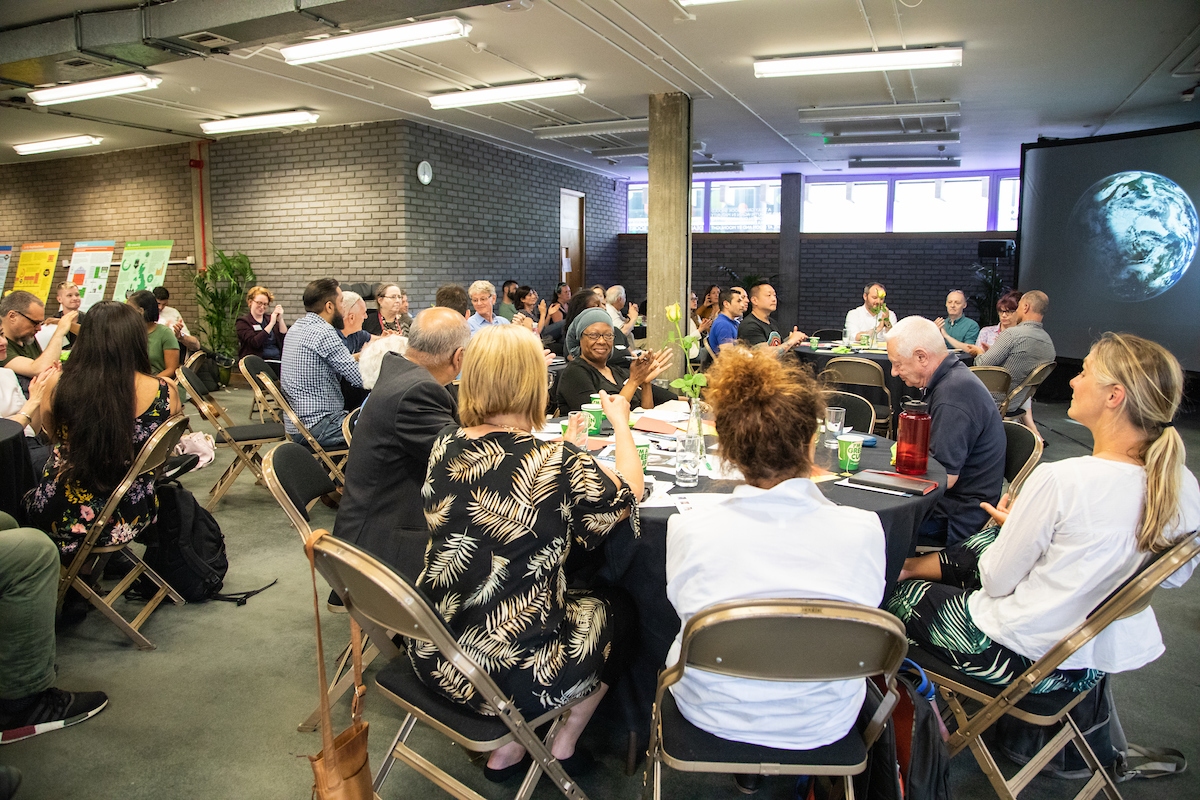
The meetings can happen online, or a mix of face-to-face and online. In any case, the entire group is typically split regularly into break-out groups with a facilitator, so everyone gets to have their say, and then comes back together to make collective decisions.
2. Learn
A good citizens’ assembly will ensure that those most knowledgable about, or affected by, the issue address the assembly. These people bring in diverse viewpoints and proposals.
An important aspect of any citizens’ assembly is making sure assembly members have access to high quality and diverse information from a range of experts and other stakeholders. This is not easy, but it is possible.
3. Discuss
A good citizen’s assembly give plenty of opportunity for participants to discuss, listen and talk to each other – and give reasons for their opinions.
Process, process, process. We cannot over-emphasise the importance of the design of the deliberative process. Because of course it is not good enough to simply select a broadly representative bunch of people by lottery, and then throw them in a room together and say “Decide!”. So, typically, professional community engagement facilitators are used to design and run an assembly that alternates between plenary and small group discussions, between learning, enquiring, developing informed opinions, and finally making decisions.
This is often not a linear process but a more circular one, where participants learn and deliberate and make some decisions (such as prioritising options or people they want to hear more from) before going into more cycles of learn » deliberate » decide.
4. Decide!
Ultimately citizens’ assemblies are about making political recommendations and decisions, so when the assembly finishes, decisions must be made. Often the participants themselves will come up with the final list of questions to be voted on – and this list of questions should be made by consensus. Everyone should agree that the questions are the important things to decide upon.
The answersare a different matter. It may be that the answer is a simple “yes” or “no” to each question, but more often than not a more nuanced approach can be taken, with participants grading their enthusiasm for differing options (e.g. rating them on a scale from “strongly agree” to “strongly disagree”). This gives more information about strong minority opposition (and the level and strength of support) for the various options.
However, as important as the final decisions and recommendations are, it is also vital to record the reasons for those recommendations. This is another thing that sets a citizens’ assembly apart from, for example, referenda or opinion polling. It is another reason why people trust citizens’ assemblies – you not only find out what is decided, but why that decision was made.
What makes a good citizens' assembly?
Standards for citizens' assemblies.
What is deliberation?
What do we mean when we say that citizens' assemblies are a form of "deliberative democracy"?